















![How Much Does It Cost to Rent a Boom Lift? [2026 Prices]](https://res.cloudinary.com/dsfzcj5qk/image/upload/f_auto,c_limit,w_450,q_auto:low/blog/cost-guides/boom-lift-rental-cost.jpg)
![How Much Does It Cost to Rent a Boom Lift? [2026 Prices]](https://res.cloudinary.com/dsfzcj5qk/image/upload/f_auto,c_limit,w_1000,q_auto:low/blog/cost-guides/boom-lift-rental-cost.jpg)


How Much Does It Cost to Rent a Boom Lift? [2026 Prices]
By Paolo Di Donato, Head of Sales at DOZR | Updated March 2026
Boom lift rental cost averages $580 per day, $1,440 per week, or $3,272 per month across the United States and Canada. These numbers come from 2,992 actual rental quotes on the DOZR marketplace, pulled from hundreds of equipment suppliers across the U.S. and Canada. Boom lifts are also called cherry pickers, man lifts, or aerial work platforms (AWPs) depending on your region — they're all the same category of equipment.
Daily rates range from $130 to over $5,000 depending on the boom lift's reach height, whether it's articulating or telescopic, and your rental location. A 34-foot electric boom lift for a week of warehouse work will cost a fraction of what you'd pay for a 150-foot diesel telescopic on a monthly infrastructure job.
Below, we break down pricing by height, city, boom type, and the cost factors that matter most.
Average Boom Lift Rental Costs
| Rental Duration | National Average | Typical Range |
|---|---|---|
| Daily | $580 | $130 – $1,500 |
| Weekly | $1,440 | $400 – $4,000 |
| Monthly | $3,272 | $900 – $5,000+ |
The per-day cost drops significantly on longer rentals. A weekly rate works out to roughly $206/day — a 64% discount compared to booking day-by-day. Monthly rates push that even further, averaging around $109/day.
For any project lasting four days or more, the weekly rate pays for itself. Two weeks or longer? Go monthly and cut your effective daily cost by 70%.
Boom Lift Rental Cost by Size
Height is the single biggest factor in boom lift rental pricing. A 30-foot boom lift and a 150-foot boom lift aren't even in the same pricing universe.
| Size Category | Height Range | Avg Daily | Avg Weekly | Avg Monthly | Common Uses |
|---|---|---|---|---|---|
| Small | 30 – 40 ft | $200 – $400 | $550 – $1,100 | $1,200 – $2,500 | Warehouses, building maintenance, signage |
| Medium | 40 – 60 ft | $350 – $700 | $900 – $1,800 | $2,000 – $3,800 | Commercial construction, electrical, tree work |
| Large | 60 – 120 ft | $600 – $1,500 | $1,500 – $4,000 | $3,500 – $8,000 | High-rise work, bridge inspection, industrial |
| Extra-Large | 120 – 180 ft | $1,500 – $5,000+ | $4,000 – $12,000+ | $8,000 – $20,000+ | Wind turbines, specialty infrastructure |
Two pricing cliffs to watch for: The jump from medium to large is steep — once you cross 60 feet, you're dealing with heavier machines that require specialized transport, and fewer suppliers carry them. Above 120 feet, availability gets tight and pricing reflects that.
Don't rent more reach than you need. If your working height is 45 feet, a 50-foot boom lift handles it. You don't need a 60-footer "just in case."
Boom Lift Rental Cost by City
Rental pricing varies considerably by market. Texas cities tend to run higher than the national average, while Philadelphia and Mississauga sit well below it. Here's what DOZR marketplace data shows across 20 cities:
| City | Avg Daily | Avg Weekly | Avg Monthly | Data Points |
|---|---|---|---|---|
| Orlando, FL | $735 | $1,768 | $3,890 | 48 |
| Charlotte, NC | $725 | $1,787 | $4,031 | 24 |
| Fort Worth, TX | $735 | $1,757 | $3,938 | 21 |
| Miami, FL | $729 | $1,781 | $3,428 | 60 |
| San Antonio, TX | $716 | $1,746 | $3,657 | 54 |
| New York, NY | $708 | $1,700 | $3,716 | 21 |
| Phoenix, AZ | $691 | $1,719 | $3,886 | 42 |
| Ottawa, ON | $679 | $1,827 | $4,382 | 45 |
| Dallas, TX | $662 | $1,649 | $3,441 | 93 |
| Houston, TX | $600 | $1,484 | $3,058 | 138 |
| Austin, TX | $596 | $1,435 | $2,982 | 99 |
| Minneapolis, MN | $543 | $1,425 | $3,310 | 27 |
| Gainesville, FL | $556 | $1,327 | $2,624 | 126 |
| Chicago, IL | $537 | $1,379 | $2,991 | 33 |
| Tampa, FL | $533 | $1,321 | $2,890 | 42 |
| Atlanta, GA | $530 | $1,293 | $2,575 | 87 |
| Toronto, ON | $522 | $1,428 | $3,669 | 303 |
| Los Angeles, CA | $389 | $1,130 | $2,842 | 93 |
| Philadelphia, PA | $380 | $886 | $1,989 | 129 |
| Mississauga, ON | $370 | $1,027 | $2,591 | 78 |
The regional spread tells a story. Florida cities (Orlando, Miami) run 25–30% above the national average — likely driven by year-round construction activity and hurricane restoration demand. The Texas markets (Dallas, Houston, Austin, San Antonio) cluster in the $596–$716/day range, reflecting the state's massive construction volume and strong demand for aerial equipment.
Canadian markets show an interesting split. Ottawa runs high at $679/day with the most expensive monthly rates on the list ($4,382). Toronto sits closer to the middle at $522/day. Mississauga, just outside Toronto, comes in as the cheapest market at $370/day — a 29% discount over its neighbor, likely due to supplier density along the 401/403 corridor.
Philadelphia and Los Angeles both sit well below the national average, which may surprise contractors used to LA's high cost of living. The LA market benefits from intense supplier competition.
Articulating vs. Telescopic Boom Lifts
Two types of boom lifts dominate the rental market, and the type you need affects your rental cost.
Telescopic (Stick) Boom Lifts
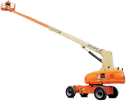
Telescopic booms extend in a straight line. The boom sections slide out in a straight line to reach maximum height and horizontal distance. They deliver the best reach for the money and are the go-to choice for open job sites where you need to get up and out.
Best for: high-rise construction, utility line work, open-area industrial maintenance. Common manufacturers in rental fleets include JLG, Genie (Terex), Haulotte, Manitou, and Snorkel.
Articulating (Knuckle) Boom Lifts
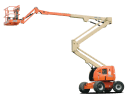
Articulating booms have one or more "knuckle" joints that let the boom bend and navigate around obstacles. They can reach up, over, and around obstructions that a straight telescopic boom simply can't access.
Best for: tight job sites, working around building overhangs, navigating structural steel, reaching over equipment.
Price Difference
Articulating boom lifts typically cost 10–20% more than telescopic models at the same reach height. The added cost reflects the more complex hydraulic systems and the premium contractors place on maneuverability. On a $580/day average, that means an articulating boom might run $640–$700/day compared to a telescopic at $530–$580/day.
If your job site is open with a clear line of sight to the work area, save money with a telescopic. If you need to navigate around obstacles or reach difficult angles, the articulating premium is worth every dollar. For jobs that require both vertical reach and the ability to place heavy materials at height, a telehandler may be a better fit than a boom lift.
Towable Boom Lift Rental Cost
Towable boom lifts are a category that often gets overlooked but serves a specific niche well. These units mount on a trailer chassis and tow behind a pickup truck or SUV — no flatbed delivery required.
| Feature | Towable Boom Lift | Self-Propelled Boom Lift |
|---|---|---|
| Platform height | 30 – 55 ft | 30 – 180 ft |
| Transport | Tow behind a truck (standard hitch) | Flatbed delivery required |
| Daily rental | $150 – $350 | $350 – $5,000+ |
| Mobility on site | Stationary once positioned | Drives to work area |
| Power source | Gas/electric hybrid or battery | Diesel or electric |
| Best for | Tree trimming, sign work, painting, light maintenance | Construction, industrial, any job needing repositioning |
Typical towable boom lift rental cost: $150–$350/day, $400–$900/week, or $1,000–$2,200/month.
Towable boom lifts work well for tree services, building maintenance, sign installation, and residential painting — any job where the lift stays in one position for the duration of the work. They're not practical for construction sites where the boom needs to reposition frequently, since you have to lower the platform, hitch the trailer, and tow it to the next spot.
The cost savings over a self-propelled boom lift are significant — 50–70% less per day at comparable heights. If your job doesn't require driving the boom to different positions on site, a towable unit is the budget-smart choice.
Cost Factors That Affect Boom Lift Rental Pricing
Beyond the base rate, several factors shape your final cost.
1. Rental Duration
The single easiest way to lower your per-day cost. Weekly rates save roughly 50–60% over the daily rate, and monthly rates push savings to 70%+. Even if you only need the boom lift for 5 days, book the weekly rate — it's almost always cheaper than five individual days.
2. Boom Lift Height
Already covered above, but worth emphasizing: every 20 feet of additional reach adds $100–$300/day to the rental cost. Measure your required working height carefully before renting. Working height \= platform height + roughly 6 feet of standing reach.
3. Articulating vs. Telescopic
A 10–20% price premium for articulating models. Choose based on job site conditions, not preference.
4. Electric vs. Diesel
Electric boom lifts cost less to rent — roughly 15–25% below diesel models of the same height. They produce zero emissions, operate quietly, and won't mark up finished floors. The tradeoff: they're limited to flat, paved surfaces and indoor use. If you're working outside on rough terrain, diesel is your only option.
5. Delivery and Pickup Fees
Boom lifts don't drive themselves to your job site. Delivery fees typically run $150–$500+ depending on distance from the supplier's yard and the size of the machine. Larger boom lifts (80ft+) require lowboy trailers and can push transport costs past $1,000 for longer hauls.
Ask about delivery costs upfront. Some suppliers include delivery within a certain radius; others charge by the mile.
6. Insurance and Damage Waiver
Most rental companies offer (or require) a damage waiver. This typically adds 10–15% to the rental cost but caps your liability if the machine is damaged. Your general liability policy may cover rented equipment — check with your insurer before doubling up.
7. Terrain Requirements
Rough terrain boom lifts with 4WD, foam-filled tires, and higher ground clearance command a premium over standard models. If your job site is unpaved, muddy, or uneven, you'll need the rough terrain version — budget 15–25% more.
8. Seasonal Demand
Construction season (spring through fall in most markets) drives rental prices higher. If your project has scheduling flexibility, booking during winter months or shoulder seasons can save 10–20%. Supply tightens in summer, and popular sizes like 40–60ft boom lifts can be hard to find without advance notice.
Which Boom Lift Size Do You Need?
Match the machine to the job. Renting too small wastes time if you can't reach the work. Renting too large wastes money and may create logistics headaches on tight sites.
30 – 40 ft Boom Lifts
- Warehouse racking installation and maintenance
- Building facade work on 2–3 story structures
- Indoor construction and fit-out projects
- Sign installation and maintenance
- Light commercial painting and caulking
40 – 60 ft Boom Lifts
- Commercial construction (4–6 story buildings)
- Tree trimming and removal
- Electrical and lighting work
- Exterior building maintenance
- Parking structure construction
60 – 80 ft Boom Lifts
- High-rise construction and curtain wall installation
- Bridge inspection and maintenance
- Industrial plant maintenance (refineries, manufacturing)
- Large arena and stadium work
- Cell tower maintenance
80 – 120 ft Boom Lifts
- Large commercial and infrastructure projects
- Utility transmission line work
- High-rise window installation (10+ stories)
- Crane-assisted assembly at height
- Power plant and refinery turnarounds
120 ft+ Boom Lifts
- Wind turbine installation and maintenance
- Specialty infrastructure projects
- Very tall building construction
- Major bridge construction and repair
- Industrial chimney and stack work
When calculating the height you need, remember: working height \= platform height + 6 feet. A 60-foot boom lift gives you a working height of roughly 66 feet. Measure from grade level to the highest point you need to reach, subtract 6 feet, and rent accordingly.
Should You Rent or Buy a Boom Lift?
Boom lifts are one of the clearest cases for renting over buying. Most contractors need aerial access intermittently — a few weeks here, a month there — not year-round. The economics strongly favor renting unless you're a specialty aerial contractor running boom lifts 200+ days per year.
| Factor | Rent | Buy |
|---|---|---|
| Upfront cost | $0 | $40,000–$200,000+ depending on height |
| Monthly cost (60 ft) | $3,272/month when needed | $2,500–$4,500/month (loan + insurance + maintenance) |
| Annual inspection | Supplier's responsibility | Your responsibility ($500–$1,500/year) |
| Storage | None | Indoor storage recommended |
| Depreciation | None | 10–15% per year |
| Height flexibility | Rent the exact size per job | Locked into one reach height |
Rent when: Your boom lift utilization is under 150 days per year, your projects require different reach heights, or you need both articulating and telescopic types at different times. This covers the vast majority of general contractors, electricians, painters, and facility maintenance teams.
Buy when: You're a specialty aerial contractor (window washing, cell tower maintenance, wind turbine service) running the same boom lift class 200+ days per year. At that utilization, ownership costs beat rental rates — but you also take on inspection liability, storage, and the risk of a depreciating asset.
Frequently Asked Questions
How much does it cost to rent a boom lift?
The national average boom lift rental cost is $580/day, $1,440/week, or $3,272/month based on 2,992 rental quotes across the DOZR marketplace. Prices vary by boom lift size, type, and location — small 30-foot models start around $200/day, while 120-foot+ machines can exceed $5,000/day.
What's the difference between a boom lift and a scissor lift?
Boom lifts extend outward and upward on an articulated or telescopic arm, giving you both vertical and horizontal reach. Scissor lifts go straight up on a crisscross frame — they offer a larger platform but zero horizontal reach. Boom lifts cost more to rent but can access areas a scissor lift simply can't reach.
Do I need a license to operate a boom lift?
In the U.S., OSHA requires boom lift operators to be trained and certified under ANSI A92.22 and A92.24 standards. In Canada, provincial regulations apply — Ontario requires operators to meet CSA B354 standards. Most rental companies offer operator training or can connect you with a certified trainer. Never operate a boom lift without proper training — proper training prevents falls and contact with overhead hazards.
What's the cheapest way to rent a boom lift?
Book a monthly rate whenever possible — monthly pricing averages $109/day versus $580/day for single-day rentals. Beyond rental duration, choose a telescopic over articulating (10–20% cheaper), electric over diesel for indoor work (15–25% cheaper), and avoid renting more height than you need. Getting quotes from multiple suppliers through a marketplace like DOZR lets you compare prices in one place.
Can boom lifts be used outdoors?
Yes — most boom lifts are designed for outdoor use. Diesel and dual-fuel models handle rough terrain, wind, and weather. Electric boom lifts are primarily for indoor use or flat outdoor surfaces. All boom lifts have maximum wind speed ratings (typically 28 mph / 45 km/h), and operators should lower the platform during high winds or storms.
How much does boom lift delivery cost?
Delivery fees range from $150 to $500+ for standard boom lifts, depending on distance from the supplier's yard. Large machines (80ft+) may require oversize transport permits and specialized trailers, pushing delivery costs above $1,000. Some suppliers include delivery within a set radius. Always confirm delivery and pickup fees before booking.
What size boom lift do I need for 50 feet of working height?
Working height equals platform height plus about 6 feet of operator reach. For a 50-foot working height, you need a boom lift with a platform height of at least 44 feet — a 45-foot or 50-foot model handles this. Don't oversize. A 60-foot boom lift rents for $100–$300/day more than a 45-footer and takes up more space on site.
Are there discounts for longer boom lift rentals?
Absolutely. Weekly rates offer 50–60% savings over daily pricing, and monthly rates save 70% or more per day. On DOZR, the discount is built into the listed weekly and monthly rates — no negotiation required. If your project runs longer than expected, most suppliers will convert to a longer-term rate retroactively if you ask.
What size boom lift do I need for a 2-story or 3-story building?
A 2-story building typically peaks at 20–25 feet. A 34–40 ft boom lift reaches comfortably with room for the operator to work at the roofline or upper windows. For a 3-story building (30–35 feet at the peak), a 45–50 ft boom lift provides adequate reach. Always calculate working height as your target height minus 6 feet of operator reach — that's the minimum platform height you need.
Can I use a boom lift in high winds?
Most boom lift manufacturers set a maximum operating wind speed of 28 mph (45 km/h). Above that, the platform must be lowered and work stopped. Some models have lower limits — always check the operator's manual for your specific unit. Wind at height can be significantly stronger than at ground level. If sustained winds are forecast above 20 mph, plan for delays. Operating above rated wind speeds is an OSHA violation and a serious safety risk.
Will a boom lift damage my lawn or driveway?
Self-propelled boom lifts weigh 10,000–50,000+ lbs depending on size. A large diesel boom lift will leave ruts in soft turf and can crack residential driveways not designed for heavy loads. Solutions: use plywood sheets or crane mats to distribute weight, choose a towable boom lift (much lighter), or rent a crawler boom lift with rubber tracks that spread ground pressure. Electric boom lifts (under 40 ft) are lighter and cause less damage than diesel models.
How much does it cost to rent a boom lift for a day?
A single-day boom lift rental averages $580 across all sizes. Small boom lifts (30–40 ft) start around $200–$400/day, while large models (60–120 ft) run $600–$1,500/day. Daily rates are the most expensive option — switching to weekly saves about 64% per day.
How much does it cost to rent a boom lift for a week?
Weekly boom lift rental averages $1,440, working out to roughly $206/day — a 64% savings over daily pricing. Most short-term commercial and maintenance projects fall into the weekly rental window.
How much does it cost to rent a boom lift for a month?
Monthly boom lift rental averages $3,272, bringing the effective daily rate down to about $109/day — an 81% savings versus the daily rate. Any project running longer than two weeks should lock in the monthly rate.
Prices last updated March 2026. All pricing data sourced from the DOZR marketplace based on 2,992 rental quotes from hundreds of equipment suppliers across the U.S. and Canada. Actual rates may vary by availability, specific machine configuration, and local market conditions.
DOZR connects contractors and project managers with local equipment rental suppliers. Compare boom lift rental prices from multiple suppliers in your area — get a quote on DOZR.
About Our Data
The pricing in this guide comes from 2,992 actual rental transactions on the DOZR marketplace — not estimates, not surveys, and not manufacturer list prices. Each data point represents a real quote between a contractor and a local equipment supplier.
DOZR aggregates rental pricing from hundreds of equipment suppliers across the United States and Canada. The averages and ranges in this guide reflect real market conditions as of March 2026. Prices are updated quarterly as new transaction data flows through the marketplace.
Methodology: National averages are calculated across all boom lift sizes and geographies. City-level pricing reflects the average of all transactions within that metro area. Size-class pricing is segmented by platform height. All U.S. prices are in USD; Canadian city prices are in CAD unless otherwise noted.
About the author: Paolo Di Donato is the Head of Sales at DOZR, where he works directly with equipment rental suppliers and contractors across North America. Paolo oversees pricing strategy and supplier relationships, giving him firsthand visibility into rental market trends and regional pricing dynamics.
About the Author
Head of Sales at DOZR
Paolo Di Donato is Head of Sales at DOZR with extensive experience in the heavy equipment rental industry. His insights on equipment pricing are backed by thousands of real rental transactions across the DOZR marketplace.
View on LinkedIn →