
















![How Much Does It Cost to Rent a Scissor Lift? [2026 Prices]](https://res.cloudinary.com/dsfzcj5qk/image/upload/f_auto,c_limit,w_450,q_auto:low/blog/cost-guides/scissor-lift-rental-cost.jpg)
![How Much Does It Cost to Rent a Scissor Lift? [2026 Prices]](https://res.cloudinary.com/dsfzcj5qk/image/upload/f_auto,c_limit,w_1000,q_auto:low/blog/cost-guides/scissor-lift-rental-cost.jpg)


How Much Does It Cost to Rent a Scissor Lift? [2026 Prices]
By Kelly Garrett, Head of Inside Sales at DOZR | Updated March 2026
The average scissor lift rental cost is $223/day, $495/week, or $984/month based on 4,460 real rental transactions across the DOZR marketplace. Prices range from $56/day for a compact 19ft electric unit to nearly $2,000/day for a 60ft rough terrain model on a rush delivery.
Scissor lifts are the most commonly rented piece of aerial equipment in North America. They show up on nearly every commercial construction site, warehouse remodel, and facility maintenance job. Whether you need one for a day of ceiling work or a six-month tenant buildout, this guide breaks down exactly what you should expect to pay — with real marketplace data, not estimates.
Average Scissor Lift Rental Costs
Here are the national average rental rates based on DOZR marketplace data:
| Rental Period | Average Cost | Savings vs. Daily Rate |
|---|---|---|
| Daily | $223 | --- |
| Weekly | $495 | \~55% per day |
| Monthly | $984 | \~75% per day |
A weekly rental works out to roughly $71/day — less than a third of the daily rate. Monthly rentals drop the effective daily cost to about $33/day. If your project runs longer than three days, a weekly rental almost always makes more sense. If it runs longer than two weeks, go monthly.
The price range across the marketplace is $56 to $1,990 per day. That spread reflects the massive difference between a small electric scissor lift for indoor work and a large rough terrain unit delivered to a remote jobsite.
Scissor Lift Rental Cost by Platform Height
The single biggest factor in scissor lift pricing is how high you need to go. Platform height determines the size of the machine, the power system it uses, and the logistics required to deliver it.
| Height Range | Type | Daily Rate | Weekly Rate | Monthly Rate | Common Uses |
|---|---|---|---|---|---|
| 19-26 ft | Compact Electric | $100 - $200 | $225 - $475 | $450 - $900 | Warehouse work, retail remodels, light fixture replacement, painting |
| 26-32 ft | Standard Electric/Hybrid | $150 - $300 | $350 - $700 | $700 - $1,400 | Commercial construction, HVAC installation, electrical, drywall |
| 32-40 ft | Large Electric/Diesel | $250 - $500 | $575 - $1,100 | $1,100 - $2,200 | Structural steel, exterior work, commercial buildouts |
| 40-60 ft | Rough Terrain (Diesel) | $400 - $700 | $900 - $1,600 | $1,800 - $3,200 | Large-scale construction, industrial, bridge work, steel erection |
Two pricing thresholds matter here:
The jump from 26ft to 32ft is where prices start climbing. Below 26ft, you're renting a compact electric unit that fits through a standard doorway and can roll onto a freight elevator. Above 32ft, the machine is heavier, wider, and almost always requires flatbed delivery.
40ft and above means rough terrain pricing. Once you cross 40ft of platform height, you're into diesel-powered rough terrain scissor lifts. These machines weigh 10,000-15,000 lbs, have four-wheel drive, and cost two to three times more than their electric counterparts.
The 26ft electric scissor lift is the rental sweet spot. It handles 90% of indoor commercial work, costs $150-$300/day, and is available from nearly every supplier on the platform.
Scissor Lift Rental Cost by City
Rental rates vary significantly by market. Supply concentration, demand from local construction activity, and delivery distances all play a role. Here is what DOZR customers are actually paying across 27 cities:
| City | Avg Daily | Avg Weekly | Avg Monthly | Data Points |
|---|---|---|---|---|
| Phoenix, AZ | $395 | $930 | $2,224 | 123 |
| Ontario, CA | $394 | $903 | $1,830 | 36 |
| Arlington, TX | $388 | $860 | $1,818 | 45 |
| Kansas City, MO | $357 | $788 | $1,455 | 21 |
| Philadelphia, PA | $356 | $783 | $1,661 | 30 |
| Calgary, AB | $314 | $859 | $1,876 | 30 |
| El Paso, TX | $308 | $661 | $1,342 | 24 |
| Durham, NC | $291 | $621 | $1,212 | 48 |
| Indianapolis, IN | $268 | $579 | $1,099 | 27 |
| Dallas, TX | $262 | $703 | $1,663 | 150 |
| Boston, MA | $270 | $507 | $846 | 36 |
| Sacramento, CA | $244 | $514 | $843 | 24 |
| Ocala, FL | $243 | $496 | $1,110 | 48 |
| Jacksonville, FL | $226 | $475 | $992 | 81 |
| Houston, TX | $225 | $485 | $982 | 165 |
| Charlotte, NC | $223 | $466 | $861 | 120 |
| Las Vegas, NV | $223 | $475 | $883 | 228 |
| Orlando, FL | $197 | $427 | $773 | 135 |
| Kitchener, ON | $196 | $471 | $970 | 54 |
| Los Angeles, CA | $191 | $515 | $1,175 | 222 |
| Chicago, IL | $184 | $426 | $894 | 129 |
| Miami, FL | $182 | $367 | $666 | 189 |
| Brooklyn, NY | $176 | $390 | $760 | 129 |
| Toronto, ON (CAD) | $174 | $372 | $774 | 441 |
| Tampa, FL | $172 | $365 | $719 | 108 |
| Greenville, SC | $160 | $337 | $555 | 66 |
| Mississauga, ON (CAD) | $155 | $376 | $779 | 174 |
Phoenix is the most expensive market at $395/day — nearly 80% above the national average. This is driven by a construction boom, extreme heat that limits rental supply availability, and long delivery distances across the metro area. Ontario, CA ($394/day) and Arlington, TX ($388/day) are close behind, reflecting high demand in Southern California's Inland Empire and the DFW metro.
Texas cities span the full price range. Arlington ($388/day), El Paso ($308/day), and Dallas ($262/day) all sit above the national average, while Houston ($225/day) comes in right at it. The spread reflects how different local supply-demand dynamics are even within a single state.
Florida cities are consistently below average. Miami ($182/day), Tampa ($172/day), and Orlando ($197/day) all come in under the national average. Even Ocala ($243/day), which runs higher than the coastal metros, benefits from Florida's high supplier density and year-round rental activity.
Canadian cities offer strong value. Calgary ($314/day) is the exception — Alberta's energy and industrial construction keeps rates elevated. Toronto ($174/day), Mississauga ($155/day), and Kitchener ($196/day) are among the lowest-cost markets. Note: Canadian prices are in CAD, making them even more competitive when converted to USD.
Brooklyn at $176/day might surprise you given NYC's reputation for high costs. The dense concentration of rental yards in the outer boroughs keeps scissor lift pricing competitive in the metro area.
Electric vs. Rough Terrain Scissor Lifts
Your work environment determines which type you need, and the type determines the price.
Electric Scissor Lifts
Electric scissor lifts are the standard for indoor work. They produce zero emissions, operate quietly, and leave no marks on finished floors. Most models fit through standard 36-inch doorways and weigh under 5,000 lbs.
- Typical rental cost: $100 - $300/day
- Platform heights: 19ft to 40ft
- Weight capacity: 500 - 1,000 lbs
- Power: Battery-powered (charge overnight, full day of operation)
- Best for: Warehouses, retail spaces, office buildings, any indoor environment
Narrow-aisle electric models are a subcategory worth knowing about. These ultra-compact units are as narrow as 32 inches and designed for tight spaces like library stacks, data centers, and narrow retail aisles. They typically cost $100-$175/day and max out at 19-26ft.
Electric Scissor Lift Rental Cost
Electric scissor lifts are the most affordable aerial equipment you can rent. Here's what to expect:
| Height | Daily Rate | Weekly Rate | Monthly Rate |
|---|---|---|---|
| 19 ft | $100 – $150 | $225 – $350 | $450 – $700 |
| 26 ft | $150 – $250 | $350 – $600 | $700 – $1,200 |
| 32 ft | $200 – $300 | $475 – $700 | $950 – $1,400 |
| 40 ft | $250 – $400 | $575 – $900 | $1,100 – $1,800 |
Electric units account for roughly 80% of all scissor lift rentals on DOZR. Major manufacturers in rental fleets include JLG, Genie (Terex), Skyjack, Haulotte, and MEC. They're cheaper to rent, cheaper to operate (no fuel cost), and permitted in virtually every indoor work environment.
Rough Terrain Scissor Lifts
Rough terrain (RT) scissor lifts are built for outdoor work on uneven, unpaved, or muddy ground. They run on diesel or dual-fuel engines, have four-wheel drive, oscillating axles, and foam-filled tires.
- Typical rental cost: $300 - $700/day
- Platform heights: 26ft to 60ft
- Weight capacity: 1,000 - 1,500 lbs
- Power: Diesel or dual-fuel
- Best for: Outdoor construction, graded sites, industrial facilities, any unimproved surface
The cost premium for rough terrain is 2-3x. A 32ft electric scissor lift might rent for $200/day while a 32ft rough terrain unit runs $400-$500/day. You're paying for the heavier chassis, four-wheel drive system, and the larger platform that RT models offer.
Don't rent rough terrain for indoor work. The diesel exhaust, weight, and size make them impractical (and often prohibited) inside buildings. If you need height indoors, an electric model is always the right call.
What Affects Scissor Lift Rental Cost?
Rental Duration
Duration is the single largest cost lever. Moving from a daily rate to a weekly rate cuts your per-day cost by roughly 55%. Going monthly saves about 75% per day compared to the daily rate. Even if you only need the lift for four days, renting for a full week saves money.
Platform Height
Every additional 10 feet of platform height adds $50-$150/day to the rental cost. A 19ft electric unit and a 45ft rough terrain model are completely different machines at completely different price points.
Electric vs. Rough Terrain
Electric models cost 50-70% less than rough terrain equivalents at the same height. Your work environment determines which type you need — this isn't a choice you can optimize on cost alone.
Indoor vs. Outdoor Use
Indoor jobs use electric scissor lifts. Outdoor jobs on paved or level surfaces can use electric models, but uneven terrain requires a rough terrain unit. The environment dictates the machine, and the machine dictates the price.
Weight Capacity
Standard scissor lifts carry 500-750 lbs — enough for two workers and their tools. Heavy-duty models rated for 1,000-1,500 lbs cost more and are typically only available in rough terrain configurations. If you're lifting materials along with workers, confirm the platform capacity before booking.
Delivery and Pickup
Delivery charges typically run $100 to $350 each way depending on distance and machine size. A 19ft electric unit can sometimes be transported on a standard trailer. A 45ft rough terrain model requires a flatbed truck. Some suppliers include delivery in the rental rate; others charge separately. Always confirm before booking.
Insurance and Damage Waiver
Most rental suppliers offer a damage waiver or rental protection plan, typically 10-15% of the rental rate. Your commercial general liability (CGL) policy or inland marine coverage may already protect rented equipment. Verify with your insurer before adding the waiver to your rental.
Operator Training
OSHA requires that anyone operating a scissor lift receive training on that specific type of equipment. Many rental suppliers offer operator orientation at delivery. Formal OSHA-compliant training programs run $150-$250 per person and are valid for three years.
Which Scissor Lift Size Do You Need?
Matching the right size to your job avoids overpaying for capacity you don't need — or worse, getting a machine on site that can't reach your work area.
19ft Electric
- Light fixture and bulb replacement
- Warehouse inventory and racking work
- Sprinkler system installation and inspection
- Ceiling-mounted camera and sensor installation
- Retail display setup
The 19ft is the smallest and cheapest scissor lift available. It fits through standard doorways, rolls onto freight elevators, and works well in occupied spaces where noise and footprint matter.
26ft Electric
- Retail signage installation
- Drop ceiling and T-bar work
- HVAC duct installation
- Electrical conduit and panel work
- Commercial painting (interior)
- Fire suppression system work
The 26ft electric is the workhorse of the scissor lift rental market. It handles the vast majority of commercial interior work and is the most commonly rented size on DOZR.
32ft Electric or Rough Terrain
- Commercial construction (structural framing, steel stud)
- Exterior painting and cladding
- Electrical distribution and high-bay lighting
- Curtain wall installation
- Building envelope work
At 32ft, you're at the crossover between indoor and outdoor use. Electric models exist at this height but are large and heavy. For outdoor work at 32ft, most contractors move to a rough terrain chassis.
40-60ft Rough Terrain
- Large-scale commercial and industrial construction
- Steel erection and structural work
- Bridge maintenance and repair
- Facade work on mid-rise buildings
- Industrial plant maintenance
- Stadium and arena construction
These are serious machines. A 60ft scissor lift has a working height of about 66ft, weighs over 14,000 lbs, and requires a clear, level area of 15ft x 8ft. They're typically rented by the month for major construction projects.
Scissor Lift vs. Boom Lift: Which Do You Need?
Scissor lifts and boom lifts are both aerial work platforms, but they solve different problems. Renting the wrong one wastes money and slows down your job.
| Feature | Scissor Lift | Boom Lift |
|---|---|---|
| Movement | Straight up (vertical only) | Up, out, and over (articulating or telescopic) |
| Platform size | Large (fits 2-4 workers + materials) | Small (1-2 workers) |
| Max height | \~60 ft | \~185 ft |
| Horizontal reach | None | Up to 75 ft |
| Average daily cost | $223 | $580 |
| Best for | Working along a wall, ceiling, or surface | Reaching over obstacles or into tight spots |
Choose a scissor lift when you need to work along a surface — painting a wall, running conduit across a ceiling, installing ductwork. The large platform lets multiple workers spread out with tools and materials.
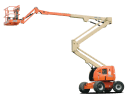
Choose a boom lift when you need to reach over or around something — clearing a parapet wall, accessing the side of a building over landscaping, or reaching into a structural opening. Boom lifts cost roughly 2.5x more than scissor lifts, so don't rent one unless you genuinely need the articulation.
For a full breakdown, see our Boom Lift Rental Cost Guide.
Should You Rent or Buy a Scissor Lift?
Scissor lifts are among the most commonly rented — and least commonly owned — pieces of equipment for good reason. Unless your business uses a scissor lift daily for months at a time, renting beats owning.
| Factor | Rent | Buy |
|---|---|---|
| Upfront cost | $0 | $15,000–$80,000 depending on type |
| Monthly cost (26 ft electric) | $984/month when needed | $800–$1,500/month (loan + insurance + maintenance) |
| Annual inspection | Supplier's responsibility | Your responsibility ($300–$800/year) |
| Storage | None | Indoor/covered storage needed for battery |
| Depreciation | None | 10–15% per year |
| Battery maintenance | Supplier handles it | Replacement battery: $2,000–$5,000 |
Rent when: You need a scissor lift for specific projects — tenant buildouts, facility maintenance, seasonal painting or HVAC work. This covers 90%+ of scissor lift users. Even facility maintenance teams that use scissor lifts regularly often rent because different jobs require different heights.
Buy when: You're a specialty contractor (sprinkler installers, commercial painters, HVAC) running the same scissor lift 200+ days per year at the same height. At $33/day effective monthly rate, a purchased 26 ft electric pays for itself in about 18 months of daily use.
Frequently Asked Questions
How much does it cost to rent a scissor lift?
The national average scissor lift rental cost is $223/day, $495/week, or $984/month. Prices range from $56/day for a compact 19ft electric model to $700+/day for a 60ft rough terrain unit. Weekly and monthly rates offer significant savings — about 55% and 75% per day respectively compared to the daily rate.
What is the cheapest scissor lift to rent?
A 19ft electric scissor lift is the most affordable option, typically renting for $100-$150/day or $450-$700/month. These compact units are ideal for indoor work like warehouse inventory, light fixture replacement, and ceiling-mounted installations.
Do I need a license to operate a scissor lift?
You don't need a government-issued license, but OSHA (in the US) and provincial regulations (in Canada) require that operators receive training on the specific type of scissor lift they'll be using. This includes pre-operation inspection, safe operating procedures, and fall protection. Many rental suppliers provide a basic orientation at delivery. Formal training courses typically cost $150-$250 per operator.
Can scissor lifts be used outside?
Yes, but the type matters. Rough terrain scissor lifts are built for outdoor use on uneven, unpaved, or graded surfaces. They have diesel engines, four-wheel drive, and heavy-duty tires. Electric scissor lifts can be used outdoors on flat, paved surfaces like parking lots or loading docks, but they're not rated for slopes, soft ground, or high winds. Most manufacturers set a maximum wind speed of 28 mph for outdoor operation.
What's the maximum height of a scissor lift?
The tallest scissor lifts reach platform heights of approximately 60 feet, which gives a maximum working height of about 66 feet (platform height plus the reach of the operator). Models above 50ft are exclusively rough terrain diesel units and are primarily used on large construction and industrial projects.
How much weight can a scissor lift hold?
Standard electric scissor lifts have platform capacities of 500-750 lbs — enough for two workers and a reasonable set of tools. Larger rough terrain models can carry 1,000-1,500 lbs, supporting heavier materials and additional workers. Always check the capacity plate on the unit and factor in the weight of all workers, tools, and materials before operating.
What's the difference between a scissor lift and a boom lift?
A scissor lift moves straight up and provides a large work platform for multiple workers. A boom lift has an articulating or telescopic arm that can reach up, out, and over obstacles, but with a smaller platform (usually for one or two workers). Scissor lifts average $223/day while boom lifts average $580/day. Choose a scissor lift for working along a surface; choose a boom lift when you need to reach over or around something.
Is it cheaper to rent a scissor lift by the week or month?
Monthly rentals offer the best per-day value. A monthly rental at $984 works out to about $33/day — a 75% savings over the $223 daily rate. Weekly rentals at $495 average about $71/day — a 55% savings. As a rule of thumb: if your project runs more than 3 days, rent weekly. If it runs more than 2 weeks, rent monthly.
Can I use a scissor lift on grass or uneven ground?
Electric scissor lifts are rated for flat, paved surfaces only. Using one on grass, gravel, or sloped ground risks tipping — electric models have a narrow wheelbase and low ground clearance. For outdoor work on uneven terrain, you need a rough terrain scissor lift with 4WD, oscillating axles, and foam-filled tires. RT models are rated for slopes up to 5° (some up to 10°), but always check the spec sheet for your specific unit. Never operate any scissor lift on a slope exceeding the manufacturer's rating.
Will a scissor lift fit through a standard door?
Most 19–26 ft electric scissor lifts are 32–46 inches wide. A standard commercial door opening is 36 inches. Many compact 19 ft models fit through at 32 inches wide. The 26 ft models vary — some fit, some don't. Measure your doorway and check the spec sheet before booking. For narrow openings like residential doors (30–32 inches), you'll need a specifically narrow-aisle model. Width is listed on every DOZR equipment listing.
Scissor lift vs. scaffolding — which is cheaper?
For jobs lasting 1–3 days at heights under 30 feet, a scissor lift is almost always cheaper and faster to set up. A 26 ft electric scissor lift at $150–$250/day beats the labor cost of erecting and dismantling scaffolding. For jobs lasting weeks or months at a fixed height — like a long facade restoration — scaffolding becomes more cost-effective since there's no daily rental charge after the initial setup. Scaffolding also supports heavier material loads and gives workers more room to move.
How much does it cost to rent a scissor lift for a day?
A single-day scissor lift rental averages $223 based on DOZR marketplace data. Compact 19 ft electric models start at $100–$150/day, while 40+ ft rough terrain units run $400–$700/day. Daily rates are the most expensive option — switching to a weekly rate saves about 55% per day.
How much does it cost to rent a scissor lift for a week?
Weekly scissor lift rental averages $495, working out to roughly $71/day — a 68% savings over the daily rate. A week is the most common rental period for commercial buildout and maintenance projects.
How much does it cost to rent a scissor lift for a month?
Monthly scissor lift rental averages $984, bringing the effective daily rate down to about $33/day — a 85% savings versus the daily rate. For any project running longer than two weeks, locking in the monthly rate is almost always the right call.
Rent a Scissor Lift on DOZR
DOZR connects contractors and project managers with local equipment suppliers across the US and Canada. Compare scissor lift rental prices from multiple suppliers, book online, and get delivery to your jobsite.
Prices last updated March 2026. Based on 4,460 rental data points from the DOZR marketplace. Actual rates vary by location, availability, and supplier. Canadian city prices shown in CAD.
About Our Data
The pricing in this guide comes from 4,460 actual rental transactions on the DOZR marketplace — not estimates, not surveys, and not manufacturer list prices. Each data point represents a real quote between a contractor and a local equipment supplier.
DOZR aggregates rental pricing from hundreds of equipment suppliers across the United States and Canada. The averages and ranges in this guide reflect real market conditions as of March 2026. Prices are updated quarterly as new transaction data flows through the marketplace.
Methodology: National averages are calculated across all scissor lift sizes and geographies. City-level pricing reflects the average of all transactions within that metro area. Size-class pricing is segmented by platform height and power type (electric vs. rough terrain). All U.S. prices are in USD; Canadian city prices are in CAD unless otherwise noted.
About the author: Paolo Di Donato is the Head of Sales at DOZR, where he works directly with equipment rental suppliers and contractors across North America. Paolo oversees pricing strategy and supplier relationships, giving him firsthand visibility into rental market trends and regional pricing dynamics.
About the Author
Head of Inside Sales at DOZR
Kelly Garrett is Head of Inside Sales at DOZR. She works directly with contractors and suppliers across North America, giving her real-world insight into how equipment rental pricing varies by market, season, and project type.
View on LinkedIn →